Monday, 27 February 2012

Post 12

Draft scripts and feedback

Before finalising on our script and carrying on for the rest of the pre-production we organised as a group to have a meeting with our teacher and Becky Knapp. Becky Knapp is well known for her short films. Below is a link to show some details about Becky and her experience:
Biography - Rebecca Knapp
As a group we found it best to ask for Becky's opinion on our script because we felt that her previous experience in short films including On Life's Edge would be useful as she would be able to analyse our script and plot line from a professional and experienced point of view. I also feel that Becky was a good person to give our group feedback as she has directed her own short films and will therefore be able to give us an idea as to whether the script and narrative produced will be able to be made into a short film.

Script- Draft 1


Feedback comments on our script
After giving our script to various people familiar with the film industry we looked to seek advice for feedback which would help us to improve. After a first glance of the script they believed we would need a title page which clearly stated the name of our film on the front, the draft number of our script to help us quickly distinguish our newest draft and to enhance this we will also need the date and day in which the script was created. We will also to finish need contact details, firstly because this is how a script should look but also because if anyone needs to get in contact with us they will be able to do so. Also after a quick glance over our script they immediately saw that it was in the wrong format, the font should be twelve point courier and at the beginning of each scene we need the scene number, exterior/interior location and time of day. The dialogue must be centred and characters names do not need to be in capital letters throughout the whole script, just on their first mention. They felt the length of our script was fine as in the media industry they base the length on a page a minute so overall our short film should be around seven minutes. They also felt we needed less actors directions, the actions need to be in brackets, the script should be about showing not telling. Finally they said that on a first introduction we need a brief description of our characters including their age and who they are.

When actually looking at the context and plot of our film, they felt that in the scenes when using a mobile phone we could experiment more with the camera shots, sizes and angles. Our initial idea was to have a shot of the phone screen so the audience can read the text for themselves as well James. They also felt we needed to build up our characters personality, especially our main charcter and protagonist, James. They felt we could either do this by using other characters for example after the game John could say 'well done for saving that' or we could do this by developing his character, making him into a really nice guy, helping others, for example opening the door. The choice to make him into a nice guy also helps to enhance the selfish side to Roxanne making the audience at the end of the film happy that the gay couple are together.

To create the development of the characters there needed to be something more at stake between James and Ashley, the ideas we had for this was that maybe they are or were best friends as this explains the tension between them and helps to disguise the ending to the audience. We want our audience to be left shocked and suprised at the end of our film and both thought to do this we will need to rethink our title as 'concealed' is to obvious, the suggestion they had was maybe 'popular'. When looking at our script they also commented on the location, they suggested that we make it into a university as homosexuality is accepted more, to add they said we should look at specific locations that don't look like a school, for example the short film, Job. They also questionned the reasons why French New Wave would be good for our story and why should it be used.

Script Draft 2
Scroll down on link to find script

Group improvements after receiving feedback
After commenting and looking back at our feeback, we had a group discussion on the improvements we could make to our film. We started on the subject of the location as a group we thought it was more acceptable to be homosexual in a university than in a school as within a school you will get more snide comments and the brutality of school children. If we have our film set in a college or university there will be no use of school children or we will need to film when there are no school children around to keep in the style of Jon Luke Goddard. As a group we agreed  that we need to build up James' character, create a connection with him and the audience. To do this we thought we could enhance James' character to be a nice, kind and helpful character, for example opening the door for others. We could also make James quite an emotional character so the audience will sympathise with him by when he recieves the last text we could see him crying, wiping a tear or kicking a flower in frustration. He could also maybe send a text saying 'sorry'.

When re-analysing our characters we felt we needed to make Roxanne disliked by the audience and James liked to do this we could chage scene 2, James and Roxanne will still walk out the doors however Roxanne will bump into a small child holding some books who will look small, fragile and weak, he will then drop all of his books on the floor, Roxanne will walk away not caring however James will help the little boy pick them all up. This will make the character of James seem nice, considerate and helpful to others. By putting in the line 'Come and see me later' Roxanne to the audience puts across the image that she is self-centered and when James looks upset, she doesn't ask what is wrong she is just silent and to enforce this the camera will focus on her dialogue 'anyway'. As a group we are making the character of Roxanne disliked because at the end when we see James reveal his sexuality we want it to be seen as a good thing so being gay is seen to be positive and ok and therefore don't want Roxanne to be considered the victim. To enforce the fact that at the end scene we are happy that Ashley and James are now together we needed to make Ashley's character like by the audience and to to do this we needed to build his character. To begin this we focused on the football scene where we will reveal that James and Ashley used to be friends. This shows to the audience the reason for the tension between Ashley and James and that they 'used' to talk to each other. We will do this by either using the character of Roxanne or the football friends who will comment on the relationship between them and there past relationship. We will also build up character in the fight scene. In this scene we will establish that James is a moral character as he disagrees with the fight saying 'it's not right' and wincing. We will also develop the fact Roxanne is selfish character by her believing Ashley being beaten up is acceptable she looks and is not bothered about it at all showing she has no emotion or care for anyone but herself. Character and character relationships will be built when we see James and Ashley spend a brief moment together. James will walk along and Ashley will walk past we will have a short shot of them aknowledging each other. James will be deep in thought when seeing Ashley and will bump into someone, this person will be fine with this, 'oh you alright James'. Ashley may then bump into someone and be very apologetic, this person will not respond well. By doing this we will be showing the audience that James is a popular, liked character whereas Ashley is not because we have established his sexuality. James will stand up for Ashley and the person will stop because of James' high status.
We also agreed that we may need a change in title because 'concealed' could be seen as too revealing and may give away the plot to our film. We agreed on either 'Popular' or 'Status' as these are less revealing of James' sexuality and reflects the fact that James' popularity is what will be at stake.
We also felt that if we wanted to use Goddard's French new Wave style within our film we would need evidence to show why. To begin with we don't want to emulate the French New Wave style, just use specific elements of it. We are also using this style because we want to make our film look as natural as possible and this style will help us to do this through elements like natural lighting, this will also help us to steer away from making a generic type of film. One of the elements of French New Wave we could use is to drop the sound as they will help to highten emotion and create tension between characters.

Teacher feedback
 After making the changes from our feedback with Becky Knapp, our group then had another discussion about our new and improved script and plot line with our teacher. The main issue we had with our script was the continuity, we felt that the change between scenes almost didn't flow and some character actions can in some ways be confusing to the audience. An example of this was when the character of Ashley originally came back to the same place that he had already just been beaten up at which in your human nature you wouldn't do. We also scrapped one of our scenes as we felt that the idea of kicking some pink flowers would be difficult mainly because we don't have any on location and we didn't want to find some others and plant them there because we felt that this would look artificial. We therefore decided that we didn't want to completely scrap this scene but replace it with the same content but more believable and less artificial so we therefore replaced it with a car scene which still has the text messages and the main point to the scene but it now looks less artifical and 'fake'.   

Post 11

Script Influences

Italian neorealism
Background to Italian neorealism
Italian neorealism has had an influence on the creation of my short film, this is shown through some of the characteristics of this style. One of these is the fact that this technique doesn't use extras. This style will just film in the location naturally rather than artifically. It does this by shooting exclusively on location. Another characteristic is the the fact it portrays the subject matter of life among the working class, realism is usually always emphasized.

Dogme 95
Background to Dogme 95
Dogme 95 uses various rules when filmmaking, the main rule is the fact that it looks at traditional values of filmmaking when looking at plot, acting and them and excludes the use of special effects or intricate technology. When looking at the history of Dogme 95 its theory is very similar to Francois Truffaut's essay. Francois Truffaut created his films in the style of French 'new wave', an example of this that I have watched is 'Joles et Jim'. If abiding by the goals and rules of Dogme 95 then all filming must be done on location. Props and sets must not be brought in and if needed must be found on location. Extra sound should also not be entered unless it is digetic  

French New Wave
Background to French New Wave
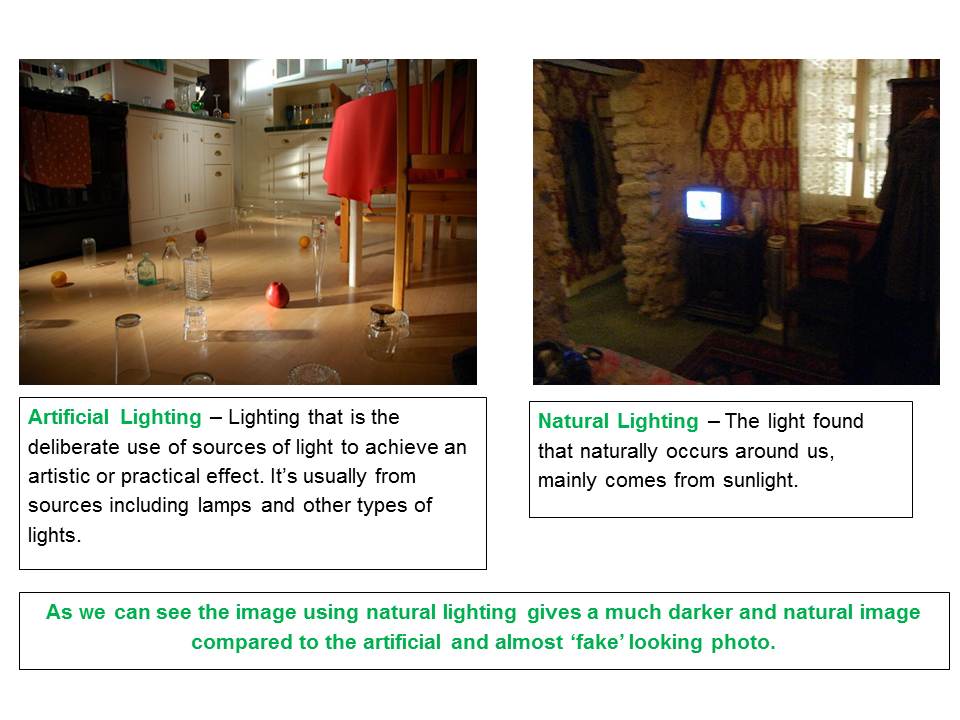
Before writing my script I have been majorly influenced by the French New Wave style of film making. I particularly like the idea of dropping sound this is because by using this technique we can project to the audience the tense atmosphere and can draw the audience into their focal point being the characters expressions rather than the dialogue. I was also influenced by the technique of using natural lighting instead of artifical lighting, I feel that this will give our film a better atmosphere. The narrative for our film deals with tackling issues and artifical lighting will give off a very different effect. This is because most artifical lighting will give a brighter effect and in my opinion brightness is usually percieved to be linked with happiness however if we use natural lighting we will give a more darker and natural effect which will hopefully in some places help to create a more tense and suitable mood to our short film. Below I will show the differences between artifical and natural lighting to demonstrate why we have chose to use natural lighting.
You Tube film clips
Kes

After creating our initial concept for our film we started looking into turning it into a proper narrative we looked at films which showed homosexuality and what sort of symbolsor activities were stereotypically associated with masculinity as the fact our charcter is gay is hidden to the audience. The main stereotypical link to masculinity was football. So we then looked at the ways in which football scenes are shot to portray the real masculinity of our character to almost enhance the fact that the audience think the character James will be gay. After watching the short football scene in Kes we liked the way it was shot. We liked the close ups of the players feet and we also liked how feeble the goalie looked which is almost the way we want James to be seen but not so obvious to the audience.

Then you can be free

We also looked at how we could end our film we all agreed from the beginning that we wanted the end of our film to almost be a suprise and also be happy that James is gay. Then after watching this short film I particularly liked the close up of the two boys hands as I felt we could use this to our advantage in our short film. I liked this because stereotypically the audience immediately assume that the hands will be a boy and a girl (James and Roxanne, his girlfriend) however instead it will be the point where we find out James is gay. After this shot we can finally reveal through the close ups of the two boys faces that we have mislead the audinece.

Waterloo Road

When creating the narrative and script for our film we also struggled choosing the location and setting of our film. Although Waterloo Road is a tv drama and not a short film I felt that this had a great influence on the choice to set our short film in a school. From watching the way the character (Josh) came out in Waterloo Road I saw that concepts like this become much more dramatic and harder to come to terms with within a school. This is because kids stick greatly to the stereotypes and anything different or unique is seen as wrong. I therefore liked the setting of a school because our film is educating young people that homosexuality should be accepted and we can display within our film how hard it can be for a teenage boy to 'come out' as it is less accepted in a school than outside and through visual images we can display this to the audience. 

Monday, 5 December 2011

Post 10

Script

Brainstorm of our initial ideas
Analysis of our title

Feedback on our idea for a short film


Post 9

Short Film Research

Why short films are made and why it could be a useful tool.
After reading the two Telegraph articles which talk about the process of production distribution and exhibition they have given me inspiration as to how I will design the making of my short film.
The long history of short films (Click to follow this link)
This article from The Telegraph displays how short films have come about and developed over the past few years. In the beginning of film making all films were short. The short films that succeeded, where "one-shot 'actuality' or 'interest' film depicting celebrities, royal processions, travelogues, current affairs and scenes from everyday life". From this I can see that audiences preferred films about everyday life and current affairs. This is mainly because audiences are able to connect with the film as it will be about something they have experienced. However 'shorts' didn't last long. "In the early 1900s, improvements in recording and editing technology allowed film-makers to produce longer, multi-shot films". The fact that technology has developed means that it is to produce longer, better, multi-shot films. This will benefit us when we come to create our films because we will have the facilities to experiment with the camera and camera angles. However because we are using the school equipment we would expect that it will be a real step down to the equipment that major film companies would use. In the article Chris Hilton is mentioned. He is a general manager at the Odeon and says that he "began working in cinemas in 1966 and recalls the unpopularity of some of these documentary shorts 'In the Sixties, you would still occasionally get short films in the programme, things like the Rank Organisation's Look at Life series (which depicted scenes of 'Swinging Britain'). But most of these were pretty boring and the audience used to use them as an excuse to pop to the loo or get some more popcorn"'. From this we can seen that the short film documentaries were unpopular and audiences like films were they can escape from reality and be part of a different world out of their experience. However they also like films to be believable with issues they can relate to but on a much wider scale. This means that I will base my short film on issues that the audience are able to relate to but also include parts which help the audience to escape reality and to include themselves into a new fantasy world. The article also states that 'With a music video, the narrative follows the rhythm of the song so there's much less freedom'. From this statement I have learnt not to try and fit the film around the music as we will have much less freedom to experiment with camera and editing and our short film will consequently turn into a music video. This article has helped us considersbly with the distribution of our film

Who are the target audiences for short films?
The target audience for short films is seen to be quite specific. There are two main groups of people that will be familiar with these short films, these are unemployed students looking for a career in this industry and the people that have already become successful within this industry. These people that have been successful within the industry will be looking at the short films to find a potential director, producer or writer that they can employ to work with them. Whereas the unemployed students will be viewing the work for inspiration.
The audience for short films again could be considered different to that of mainstream films because: 
  • They are succeeders, they are driven by their income wanting to get to a high status within the industry. Once they have achieved this powerful position they are then the audience looking to invest in a director to bring money into their company.
  • They are aspirers, these are the students who have finished their degree and are now looking for a job so that they can break into the industry. These people are driven by the motivation of a better life meaning that they will be doing a lot of research into short films to get a better understanding and to possibly get inspiration for their own amateur short films.
  • They are individualists, they like to express their opinions and views through film

Who are the target audience for the short films I have watched
Most of the short films I have watched are set in a teenage school and often tackle issues that this age group face, these include violence and bullying. The large sector of the audience watching these films are around the same age as the characters however these are split in two, the first half is for the children who are victims of bullying. The children will feel alone until they watch the short film and realise that this is a popular issue found within schools. The second will be the bullys themselves so that they will realise the damage they cause to their victims. The other audience of these films may also be the parents of these school children as they are able to experience the reality of school.

How are short films distributed?
Short films have a very different strategy when it comes to the distribution of their films compared to the theatrical (cinema) films. Up until recently short film producers have been trying to replicate the feature film way of distribution by taking 4 simple steps


1.    Take their short film out onto the circuit

2.    Try to communicate with a sales agent to try and get your short onto the television

3.    Look at possibly trying to get your shot onto a DVD to sell, either through yourself or through a sales agent

4.    Put your short film onto the internet, but only if every other solution has failed

The differences between the distributions of feature films compared to short films

·         The first difference between the two distribution techniques is that short films don’t tend to make money theatrically or in festivals as the economic motivation to screen short films theatrically in cinemas and festivals is missing.

·         Despite the point above, festivals are very important and you shouldn’t ignore them. Through these your short could win awards and could reach committed audience. Through these film festivals you may be able to secure a sales agent who may consider your film if it has been successful at the festival.

·         Short film festivals realise that they are in competition with DVD sales and online delivery of short films, it is a battle that they most likely will not win.

·         Festivals used to reject short films mainly because they are online, on television or on DVD meaning festivals may be coming to an end. However festivals won’t disappear so they will learn to work with other media.

·         Producers and directors of short films need to promote their films across all different types of media in order to get the biggest audience and profit to produce potential.
Film Festivals
Film Festivals target to audiences who seek out new and fresh short films and some festivals also offer awards. Film festivals are also a good way of distributing your film because producers, distributors and various other members of the film industry will be at these film festivals looking for short films to catch their eye. However you need to careful when distributing your film because some festivals only accept feature films or films of a certain genre. Finding a film festival can also be difficult because many target certain categories, for example some target feature films whereas others only target shorts. When entering your short film into a festival there are also awards to be one, an Oscar, Jamieson European Short Film Award, BAFTA, Scottish BAFTA, Scottish BAFTA New Talent Awards and a Jim Poole Award.

Sales Agents/International Distributors
Sales Agents, either a company or an individual are in an agreement with you, the holder of your short film to try to sell your film as widely as possible to the agent’s contacts universally.  Agents attend festivals to look for new short films that will be able to sell. Sales agents won’t be able enter your film in an international film festival but will however have a wide range of contrasts and expertise because their profession is to sell short films.

Digital Distribution – Online Downloads and Streaming
Digital Distribution is appealing to short filmmakers as you are able to digitise your film, register and upload it to various websites and potentially universally people will be able to watch it streamed, or download it to watch at audience demand. In some cases filmmakers will be able to make money from this method of distribution.

Conclusion
The most common ways to distribute a short film is to send a DVD to film festivals. They are receptive to short films and sometimes awards are given for the best short film. Major distributors attend film festivals meaning that promoting your short film is easy. You could also contact film distributors directly. Small, independant distrubutors are sometimes more receptive to short films and may suggest options for you releasing it on DVD in conjunction with other films or as part of a collection. To distribute your short film you could also talk to film reviewers, this will help promote your short film and make it well known widely. Lastely you could post parts or the whole of your short film on websites, for example YouTube or a blog to help promote and distribute it.

Source:  You’ve got it made, Short Film Distribution Guide by Nigel. R. Smith
My research on short films on homosexuality
Fair Play
  •  The film makers of this short film clip used the idea of soccer/football as this is seen as a masculine trait, he uses this sport to fool the audience into believing he is with the woman. We have used this idea in our film with James and Ashley where we use the character of Roxanne to trick the audience into believe he is straight.
  • Within the film the audience are told that 'he had hurt his knee', this is showing that he is quick to be in pain, whereas the masculine stereotype is to be butch, whereas this character is showing his feminine side by showing his emotions.
  • In this short film clip one of the homosexual couple is in denial, 'I'm in love with Marie' yet it is clear to the audience that there is a relationship between the two male characters, but when told this he states that he is 'different' showing that he wants this homosexual relationship but isn't ready for it to be openly broadcasted.
  • The writers of this short film also use the statement 'me time' which the gay character in denial uses as an escape route. An escape from the woman to see his boyfriend and an escape from his boyfriend when things start to get difficult.
Who we are


  • Homosexuality is wrong- (based on religion where it is unaccepted)
  • Convention could be that the guy character would hang around with groups of girls
  • Father trying to force him to play baseball when he was younger, he is almost forcing him to be straight which is something you can't force people to do. 'You may force him to play baseball but you can't force him to be something he's not'.
  • Unaccepted by school friends as he is beaten up and called 'queer'.
Research into your target audience
Target audience for short films is more specific compared to mainstream films. There are only two types of audience that are interested in short films these are unemployed students looking for a future in the film industry and people who are already professional in this industry.
Demographics
People employed in the industry are placed in the demographic social groups A to C1. These professionals are looking to find potential in the director, producer or other member of this film group to work for them in their company. The section made up of students would be placed in group E because they are unemployed but their background is most likely to be A to C1. This category would be viewing these short films for inspiration for their work as they are still an amateur film maker.  Most of these short films will be viewed online so the audience will be familiar with the internet therefore supporting the reasons behind the audience being from the media background.
Psychographics
The audience is again different to mainstream films. The audience is therefore split into three categories the succeeders, the aspirers and the individualists.

The Target Audience for the short films I have looked at
The short films I have looked at are mostly set in a school, some clips are of the same subject matter as mine, others are just for research of what a short film should look like and what it consists of. Most short films I have watched are about social realism (socio-realism) and deal with tackling issues. All the short films I have researched also have in the common the setting of the film and are all set in school. This therefore means that the films I have researched look at the tackling issues and problems that are faced will at school. This therefore means that the target audience is split into three sections. The first section is the kids that are going through these issues, for example being bullied or even being gay. This section of the audience are watching these types of film because they are watching how others are dealing with these issues themselves. The second section is the ones bullying or causes disruption, these are watching these short films as they are almost looking at them as a lesson, seeing what trouble they are causing and what they are putting people through. The last section of the audience is the adults and parents of the children, watching what goes on within a school enviroment and looking at the film from a different perspective and looking at how they may be able to help their child.
The target audience I am making my film for
The target audience I intend to make my film for is for children going through secondary school and maybe even parents. The short film I intend to make is going to look at issues students at secondary school go through and because it is set in a secondary school this therefore leads to the target audience being students going to secondary school. I may also make my target audience parents because as I said above it will help them to remember there childhood and how hard life can be when your young.
How I will measure how successful my short film will be
To measure the success of my short film when it is finished I will firstly put it on YouTube, this way I can then see what audiences think of my short film from the comments the audience will hopefully leave. I could also screen it at my school and get feedback from fellow pupils to see what types of results I get.

Tuesday, 1 November 2011

Post 8

Media Language

Media Language could be seen to be the understanding of the micro elements of film including camera, sound, mise-en-scene and editing and a deeper analysis of shot sizes, match-on-action, rules of continuity, framing and how they are pieced and edited together to create a sentence and therefore a language of communication. The language of film arguably the language can’t be used separately from genre, narrative, representation and audience as the knowledge of each of these influences the decisions you made throughout production.
When constructing the plot of our short film we were led by the conventions of the short film genre, for example, depicting an underlining message and constructing the story around the development of one character. This is shown in my opening sequence last year where we started to develop the film around the character of Liam and the story of his mixed up life where he turns to drug dealing.  You also want your film to be successful with its target audience and therefore the constraints of the conventions of that genre need to be acknowledged, used or diverted from, so that while audience expectations are fulfilled at the same time you are offering up a film that will be remembered for its ‘creativity’.  
Film has a seperate language known as the media language, its a way of communicating using images which is known universally. Like other languages it has rules and conventions, which we can deconstruct and understand. The narrative world of the film is also known as the diegesis which can be divided up into two areas, the mise-en-scene and the mise-en-shot. The mise-en-scene is the things we find in the scene. Most things we will find within the scene are all or mostly significant however nothing is accidental because film is not reality it is a representation of it. This includes the actors, set, costume and lighting. The mise-en-scene could reflect the production values of the films. The mise-en-shot is the process of translating mise-en-scene into shots and the relationship between the two, this includes the camera position, camera movement, shot scale (long shot/medium shot/close up), duration of the single shot, the pace of the editing and the depth of focus.

Post 7

Audience Theory
When looking at audience theory we looked at four short films and from using our background research on audience theory we analysed these using some of the following possible audience receptions:
- Dominant Hegemonic Position
- Negotiated Hegemonic Position
- Oppositional Hegemonic Position
- Aberrant Decoding
- Moral Panic
- Mode of Address

Audinece theory in existing short films
About a Girl
The first of the four short films I watched was About a Girl. This short film looks at a teenage girl who is experiencing her dreams of the average working class teenage girl. The Dominant Hegenomic Position in this short film was that it was intended to shock the audience with its ending and leave the audience with an enigma. Throughout this short film whenever the audience sees the young girl start to build up emotion it cuts to the next scene therefore to some we see that the audience won't sympathise with this young girl till we see the end scene. At the end of this short film we see her drop a baby into the canal, to begin with we see this girl is mixed up and reinforces the point that she has not got a strong relationship with her family as they would have realised this. The fact that she drops a baby into the canal shows that she can't hide these things from her mum which she claims she could. The Negotiated Hegemonic Position that the audience could see from watching this short film is the effect that teenage pregnancy would have had on the young girl. There is a short mention of the girl talking on the bus of when she 'grows up' and the fact that she has had a baby could have in some way made her feel that she is 'grown up' and seen as an adult. The oppositional hegemonic position from watching this film is that initially the audience may agree with the message coming across however there are parts of the short film clip that in some peoples opinion are wrong. One of these segments within this clip is when she throws the baby into the canal. Parts of the audience, including religous viewers would feel that someone killing a life is wrong. Some would also blame the death of this young baby on her parents as she is obviously isolated from them and if they had made more of an effort to get closer to her and look after her they would have known she was pregnant and would have been able to put it up for adoption. After the audience have finished watching this short film clip it will lead them into a moral panic. They will leave wanting to know more background on the girl and to get more of an insight into her interesting life. It will also leave the audience with unanswered questions, they will wonder why she is pregnant at such a young age and what she has done to create such a tense atmosphere and a distant relationship from her parents, whether her pregnancy has caused this.

Bro
The second film I watched when analysing audience is Bro. This short film consisted of a teenager coming to terms with his brother's disability. From the beginning of the clip the audience see that the teenager is his brothers main carer, this is shown when the teenager and his brother are making a cup of tea together and from that moment we see their main bond and how distant they are from their mother, shown through how hard she is having to work. As an audience we also see that this family come from a lower class background due to the council house they are living in and the area around it, this is also shown through the mise-en-scene of the characters clothing and items in the house, but also through the plot as the mum is working nearly every day to get money to support her family and is rely on her son to look after his disabled brother. From this as an audience we can feel sympathy for the family as not only do they have to work hard to earn some money to keep their family afloat but they also have to work hard to support their disabled child/brother. Not only do the audience feel sympathy for the family as a whole but we feel sorry for the teenage boy. He is struggling to come to terms with his brothers disability and with a family that cannot support him on a constant basis because they are busy earning their keep he is unable to learn how to deal with it at his own pace and therefore resorts to putting his brother through danger and hell to impress a girl, which makes us feel sympathy for his brother because he has been left to fight for himself and do things that menatlly he is uncapable of doing. At the end of Bro the audience sees a resolution as the teenage boy realises that his brother's disability is accepted within the community and he shouldn't be ashamed by any part of his life.

Pop Art
Pop Art is a short film about a young boy who is struggling with life and has no relationship with his father until we see a real insight into this boys feelings when a new 'blow up' boy enters his school. The preferred reading into this short film is the fact that the 'blow up' boy is bullied this is 'preffered' because from the position of the audience this is a common and familiar situation. The fact that this boy is bullied puts the audience in an uncomfortable position as it brings back memories to the audience of times when they may have been bullied or bullied others and feel guilty. Other parts of the audience may not concentrate on this out of place 'blow up' boy they may focus on the young boy who is isolated from his family and classmates, we see this primarily through the bad language, 'shithead' but also through the mise-en-scene of the shabby home he lives in and his scruffy uniform. The reason this rough background could be important is because the audience are able to have a nice relationship with the 'blow up' boy because he is helping the young boy to stay on track and his bad attitude has now turned into a better one. The audience will leave this short film feeling sad because the blow up boy has been deflated but has gone for a better life up in the sky and has succesfully changed the young boys attitude towards life.

Jade
One of the short films I watched when analysing audience is 'Jade'. In the opening of the film the audience have no connection with this girl. We can tell by her expression she is not happy and the blue atmosphere of the swimming pool, water and the pregnancy test being positive comes out blue, the colour blue is a cold colour and could show her insular attitude and when comparing the colour blue to warmer colours like red we see that she doesn't bring a warm and friendly atmosphere towards the audience. It's not till later on in the film that the audience start to connect with the girl when we realise that she is in a difficult situation as the audience we know she is in a relationship with an older man but we also know she has a relationship with someone her age. We are left with an enigma at the end of the short film as the audience don't know which one the dad is we are just left with a shot of her and her boyfriend in the car with her expression being sad.

Post 6

Representation theory

Representation
  • Describes the signs that stand in for and take the place of something else. It is through representation people know and understand the world and reality through the act of naming it. Signs are manipulated in order to make sense of the world.

What does this mean?
  • This means that media texts are intentionally composed, lit, written, framed, cropped, captioned, branded, targeted and censored by their producers, and that they are entirely artifical versions of the reality we percieve around us.
So why do we pay attention to these biased interpretations of reality
  • It is important to remember that without the media, our perception of reality would be very limited, and that we, as an audience, need these artifical texts to mediate our view of the world, in other words we need the media to make sense of reality. Therefore representation is a fluid, two way process, producers position a text somewhere in relation to reality and audiences assess a text on its relationship to reality.
Signs
  • Signs help us to decipher what exactly is being represented. Signs are the smallest piece of meaning we can use to decode meaning. Almost anything can act as a sign and more than one sign makes up a code. For example glasses and a bowtie makes the audience think of a nerd.
Why is understanding representation important?
  • Ideologies
  • Cultural beliefs or a way of looking at things.
  • Often thought of as common sense
  • Things we believe as true but aren't necessarily true.
  • Media creates and nurtures these ideas creating possible false truths for us to identify with.
Representation of Gender
The representation of men and women. Gender could be seen to be the basic category we use for sorting human beings, and it is a key issue when discussing representation. Essential elements of our own identity, and the identities we assume other people to have, come from concepts of gender, what does it mean to be a boy or a girl? Many objects, not just humans, are represented by the media as being particularly masculine or feminine, particularly in advertising, and we grow up with an awareness of what constitutes 'appropriate' characteristics for each gender.

Representation of Women
Feminism has been around for over 30 years yet media representations of women have not dramatically changed. Representations of women across all media tend to highlight the following:
  • Beauty (with narrow conventions)
  • Size/physique (within narrow conventions)
  • Sexuality
  • Emotional (as opposed to intellectual) dealings
  • Relationships (as opposed to independance/freedom)
Women are often represented as being part of a context (family, friends, colleagues) and working/thinking as part of a team. In drama, they tend to take role of helper (Propp) or object, passive rather than active. Often their passivity extends to victimhood. Men are still represented as TV drama characters up to 3 times more frequently than women, and tend to be the predominant focus of news stories. The representations of women that do make it onto our screens tend to be stereotypical in terms of conforming to the communities expectations, and characters that don't fit into these expectations are therefore seen as dangerous or deviant. Discussions of women represented in the media tend to focus on their physical appearance rather than to the reality experienced across the world.

Representations of Men
  • Masculity has more rigid stereotypes compared to femininity
  • Representations of men in the media tend to focus on physical and intellectual strength, power, sexual attractiveness, physique and independance
  • Male characters are often represented as isolated, and not needing to rely on others, (the lone hero) . If men are seen as being part of a family, it is usually part of the resolution of the narrative
  • Men are starting to find it difficult to live up to their media representation as women are to theirs mainly because of the increased media focus on masculinity, for example the growing market of male lifestyle and health magazines. 
  • As media representations of masculinity become more specifically targeted at audiences with product promotion in mind, men are encouraged to aspire to be like their role models. This is an unrealistic target and there is growing unawareness of this.
Representations of Age
  • As the audience we are quick to judge people on their age. We criticise all ages for all different reasons including the way they dress. This is because of the media, we live in an age obsessed world and all ages are subject to some of the most rigid stereotypes. There are a few common representations of age including the rebellious teen, senile old women or man, male in a mid-life crisis, middle age woman clinging to her youth and silly old men.
Representation - further detail 
Representation refers to the construction in any medium (especially the mass media) of aspects of 'reality' such as people, places, objects, events, cultural identities and other abstract concepts. These representations may be in speech or writing as well as media products.

Representation is a key concept in Media studies, much debated and discussed, examples including the riots. This means that some critics highly rate the way media representation affects our world, 'Representational values in the media shape our understanding of the world we live in and shape ourselves as individuals'. Critics debate as to whether representations in the media reflect cultural climate or do they create it. Who affects the representation?
All media texts are created in a particular institutional context, as film companies need to make money and so they therefore don't break away from conventions. This context will modify the representation. There is an interplay between the target audience, the institution and the generic conventions.
The target audience has expectations which are influenced by inscription in texts. The target audience will find representations aspirational, for example Jordan or the representation will link to the values of the target audience.
The institution will require the biggest audience for its product, unless it is the BBC or a non profit organisation, which can affect the type of representation we get.
The generic conventions provide the framework that we expect and thus the representations we expect. Genre has a big impact on representation, limiting the kinds of representation involved by the use of stereotypes or archetypes and by certain values being representation.
The micro elements of texts create larger meanings and values which construct representations. The types of codes vary depending on media form (film, tv, magazines etc)
  • Camera angles, shots, framing, shot composition
  • Editing
  • Sound and dialogue
  • Mise en scene
  • Narrative

Representation in three existing media products
Representation of gender in Doctor Who
Doctor Who represents the idea of men being in more power than women, this is shown when the Doctor gives Rose commands like 'off you go' showing the authority he has over her. However a few seconds after the "ditsy blonde" Rose is then portrayed as being clever as she is able to work out where she is, while her boyfriend stands there looking dazed and is therefore seen as "not just a pretty face". Rose is also seen as the strong female instead of the meek stereotype as her boyfriend faints at the sight of outer space whereas she is able to cope with it showing how strong she is. Women are stereotypically seen as sex objects and this is portaryed through the woman Rose who flicks her hair towards The Doctor and says 'I'll do anything'.

Representation of gender in Halloween
In the film 'Halloween' women are seen as having stereotypical domestic roles this is shown through the scene where the girls are seen baby-sitting, cooking and cleaning, which stereotypically would be seen as a role that the women would fulfill. Annie and Lynda are alson seen in a sexual way and portrayed as sex objects as Annie takes off her clothes and changes into a shirt and when Lynda flaunts her body. There is also references to social status and men being of a higher status, shown through the character of Annie's dad being the sheriff. Annie and Judith are also driven to be with their boyfriends. However Laurie is not seen as a sex object or in a sexual way as she isn't concerned with her appearance and is not driven by the thought of having a boyfriend.

Representation of age in Charlie and the Chocolate Factory
In the film 'Charlie and the Chocolate Factory we see the representation of old-age as being ill and sick and them being a 'sickly old person'. The majority of the adults  are not presented as greedy or desirous of worldly things so much as they are as enablers of their children. Mike TV’s parents gladly serve him TV dinners so they don’t have to tell their son to come to the dinner table. His dad even says Mike need only be 12 to get a real gun. Veruca’s father shuts down his factory to have his employees unwrapping candy bars. Augustus’s father eats a microphone. Violet’s father is so busy trying to shill his car dealership he barely notices what’s going on. Grandpa Joe is supposed to be the kindly loving grandparent we all did or wish we had. Grandpa Joe is supposed to be the kindly loving grandparent we all did or wish we had.

How will representation affect the designs for my new short film
When designing my short film I will research into the representations of characters concerned, looking at gender, age, ethnicity and sexuality.